In this sixth and final edition of the NBSINFRA newsletter, we look back at three years spent turning research on Nature-Based Solutions into knowledge that can travel beyond the project itself. Our first edition introduced NBSINFRA's mission and its five City Labs in Fingal, Cologne, Ruse, Aveiro and Prague as real-world testing grounds for Nature-Based Solutions. The second took readers inside the five City Lab Booklets, uncovering each territory's history, vulnerabilities and ambitions. The third followed with the City Lab story maps, weaving together scientific data, local knowledge and visual storytelling. The fourth let the cities speak for themselves through five short video clips, one for each City Lab, alongside the project's wider collection of audio-visual materials, including video interviews and webinars. And the fifth presented a suite of six info-packs distilling the scientific and methodological core of the project, from the Resilience and Sustainability Quantification Framework to the Replication Roadmap, into frameworks and tools that can be adapted well beyond NBSINFRA's five territories.
This sixth and final edition closes that journey by bringing together some of the most significant dissemination materials and results produced by NBSINFRA in the last months of the project's lifespan. The ten posters presented at our Final International Conference in Brussels showcase, side by side, the progress achieved in each City Lab and the project's cross-cutting tools. The NBSINFRA Best Practices Book synthesises the lessons, success factors and challenges gathered across the five City Labs into a practice-oriented guide aimed at policymakers, public authorities, infrastructure operators and practitioners. Prepared by UNESCO, in cooperation with the NBSINFRA consortium, the international policy brief, "Recognising Nature-based Solutions as critical infrastructure: bridging the implementation gap", translates NBSINFRA's comparative evidence into six recommendations for embedding NBS within EU resilience, planning and investment frameworks. Lastly, the five City Lab Handbooks document, city by city, how Ruse, Fingal, Aveiro, Prague and Cologne each moved through the NBS implementation lifecycle, from initial assessment to, in Cologne's case, full monitoring and evaluation. Together, they capture what NBSINFRA has learned about assessing risk, designing and implementing Nature-Based Solutions, and making the case for their recognition as critical infrastructure, into forms that policymakers, practitioners and fellow researchers can put to use.
As this chapter closes, we thank everyone who has followed, contributed to and challenged our work over the past three years. Keep following us on LinkedIn and visit our YouTube channel to stay up to date with what comes next.
Elisabete Teixeira NBSINFRA Project Coordinator
|
| |
|
Three years on: NBSINFRA's key results, ready for scale-up
|
| |
 |
|
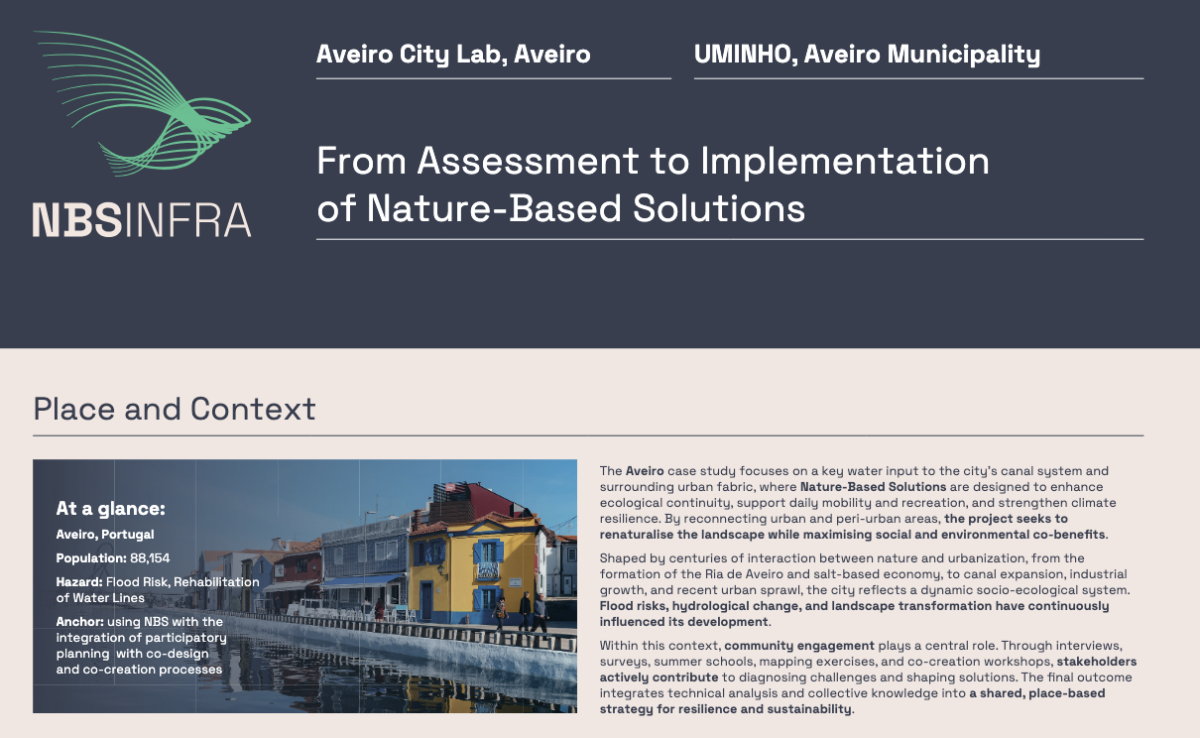
NBSINFRA's results on display: ten posters from Final International Conference (Brussels, 10 June 2026) |
|
To mark NBSINFRA's Final International Conference, the consortium produced ten posters to increase the visibility of the City Labs and of the project's cross-cutting results. Five posters trace the progress achieved in each City Lab across the NBS implementation lifecycle: Aveiro (UMINHO, Aveiro Municipality), from assessment to implementation of NBS along the city's canal system; Ruse (ASDE, Ruse Municipality), assessing risks and opportunities for NBS along the Danube and the Rusenski Lom area; Prague (CVUT, ECOTEN), from assessment to NBS in operation within the Bubny-Zátory brownfield redevelopment; Fingal (UCD, Fingal County Council), from assessment to planning of NBS addressing flood risk in Swords; and Cologne (THK), from assessment to long-term NBS resilience combining green and grey infrastructure against Rhine floods and heatwaves.
The remaining five posters showcase the project's cross-cutting tools and analyses: a comparative policy analysis of co-creation, co-implementation and collaborative governance in the Aveiro case study (UMINHO, CMA); a comparative national policy analysis of NBS for critical infrastructure resilience (UNESCO); the Resilience and Sustainability Quantification Framework, RSQF (AUTH); Digital Twins and cascade modelling for critical infrastructure (RDS, Fraunhofer, CVUT); and the replication systems, tools and pathways developed by ICONS to support the scaling of NBS beyond the project's five territories.
All ten posters were published on the NBSINFRA website and on Zenodo. |
|
|
| |
 |
|
From five City Labs to one practice-oriented guide: The NBSINFRA Best Practices Book |
|
The NBSINFRA Best Practices Book is a practice-oriented manual synthesising the key lessons, best practices and policy-relevant insights emerging from the project's five City Labs (Ruse, Fingal, Aveiro, Prague and Cologne). Structured around the five-phase NBS implementation lifecycle (Assessment, Planning & Design, Implementation, Operation & Maintenance, and Monitoring & Evaluation) it presents, for each phase, practical experiences, success factors, common challenges and recommendations for replication drawn directly from the City Labs. The book closes with five policy recommendations addressing the mainstreaming of NBS in infrastructure and planning policies, participatory governance and co-creation, digitalisation and interoperability, institutional capacity-building, and replication and scaling. Aimed at policymakers, public authorities, infrastructure operators and practitioners, it is complemented by the five dedicated City Lab Handbooks presenting the detailed results underpinning the guide. |
|
|
| |
 |
|
Six barriers, six recommendations: NBSINFRA's case for policy change |
|
Prepared by UNESCO, in cooperation with the NBSINFRA consortium, the policy brief "Recognising Nature-based Solutions as critical infrastructure: bridging the implementation gap" draws on five multi-level policy analyses conducted in Bulgaria, Czechia, Germany, Ireland and Portugal. It finds that the same six barriers, from fragmented governance to gaps in standards and monitoring, constrain the uptake of Nature-Based Solutions across strikingly different national contexts, and translates this evidence into six recommendations addressed to the European Commission, Member States, and regional and local authorities, from formally recognising NBS as critical infrastructure assets to building the standards needed to make their performance verifiable. The findings were tested and refined at the International Conference on Nature-based Solutions for Critical Infrastructure Resilience, convened by UNESCO in Brussels on 10 June 2026, and the brief was finalised for publication in August 2026. |
|
|
| |
 |
|
From Ruse to Cologne: five handbooks, one shared lifecycle |
|
NBSINFRA also produced five City Lab Handbooks, each documenting the progress of its City Lab within the NBS implementation lifecycle. Rather than standalone documents, the five handbooks are conceived as complementary contributions that together cover the full lifecycle, Assessment, Planning & Design, Implementation, Operation & Maintenance, and Monitoring & Evaluation, enabling cross-learning, comparability and replication across urban contexts. The Ruse Handbook focuses on the Assessment stage, consolidating the territorial baseline, hazard assessment, spatial-data preparation, and seismic and flood risk analyses. The Fingal Handbook covers Assessment and Planning & Design, documenting the local context and the co-design/co-creation processes carried out with stakeholders. The Prague Handbook extends to Assessment, Planning & Design, Implementation and Operation & Maintenance. The Aveiro Handbook covers Assessment, Planning & Design and Implementation, addressing local flood risks and urban resilience. The Cologne Handbook, as the most advanced City Lab, covers the complete cycle through to Monitoring & Evaluation, offering a full demonstration of the iterative NBS implementation process. |
|
|
| |
|

Funded by the European Union. Views and opinions expressed are however those of the author(s) only and do not necessarily reflect those of the European Union or REA. Neither the European Union nor the granting authority can be held responsible for them. |
| |
|